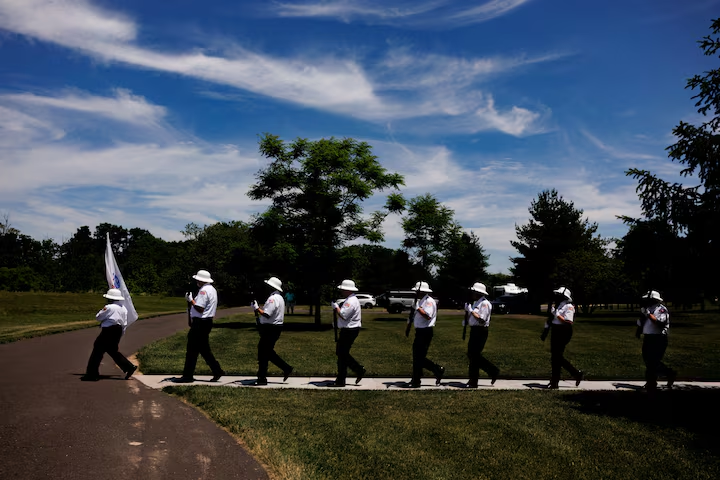
As the United States prepares to mark 250 years since the Declaration of Independence, the country finds itself deeply divided over whether there is even a shared national celebration left to hold together.
For many Americans, the upcoming semiquincentennial — the 250th anniversary of July 4, 1776 — should be a moment of unity, fireworks, and reflection. But in today’s politically polarized climate, it is increasingly becoming another flashpoint in the nation’s culture wars.
A Celebration Splintered by Politics
The political divide is starkly visible in communities like Bucks County, Pennsylvania, a swing region that mirrors the country’s broader ideological fractures.
Some residents say they are excited to celebrate what they see as America’s enduring strength. Others say they will sit out the festivities entirely, unwilling to participate in a celebration they feel has been politicized — particularly under the influence of President Donald Trump’s second term.
“I don’t want to be at the same party with people feeling enthusiastic about where our country is going,” said Betsy Halsey, 63, a retired teacher and frequent Democratic voter.
By contrast, Dan Marrazzo, a Republican business owner, sees the anniversary as a moment of pride. “The poorest person in America has a better lifestyle than some of the richest people in the rest of the world,” he said, expressing enthusiasm for hosting family and friends.

Trump’s Role in the 250th Anniversary
President Trump has placed himself at the center of the national commemoration.
A White House initiative called “Freedom 250” has been created to coordinate anniversary events alongside the congressionally established America250 Commission, raising concerns among critics that the celebration is being politicized.
The administration’s flagship event — the “Great American State Fair” on the National Mall — includes campaign-style appearances and a presidential address on July 4. Critics argue this blurs the line between national celebration and political rally.
Some Democratic-led states and artists have refused to participate, citing concerns about partisanship. The U.S. Mint has also proposed a commemorative coin featuring Trump’s likeness, further intensifying controversy.
A Nation Struggling With Shared Identity
Polls suggest the division runs deep. Roughly one in five Americans say they will not celebrate Independence Day this year. Among Democrats, that figure rises significantly.
Even more striking, a large share of Americans reportedly doubt whether the country will remain stable for another 250 years.
Historians say this level of pessimism is unusual — but not unprecedented.
“Other major anniversaries, including in 1876 and 1976, also took place during periods of national crisis,” said Yale historian Beverly Gage. “What is striking today is how widespread the sense of disillusionment has become.”
Bucks County: A Microcosm of National Division
Bucks County, once considered politically moderate, has become a symbolic battleground in American politics. Trump narrowly won the county in the 2024 election by fewer than 300 votes out of roughly 400,000 cast.
Local residents describe a community where even historical memory has become contested. Debates over education, book bans, and election integrity have intensified tensions.
Some residents see the holiday as inseparable from current politics. Others insist it should remain a nonpartisan moment of reflection.
“I love my country. I am a proud American,” said one local educator. “But this version of the celebration does not feel like it’s about America.”
Competing Narratives of Patriotism
Supporters of the upcoming celebrations argue that Independence Day should transcend political disagreement.
Jim Worthington, a Trump supporter and gym owner, said the milestone should be embraced regardless of who holds office. “This is a celebration of 250 years of history — the greatest experiment in the history of the world,” he said.
Others, however, feel alienated from the national narrative. Some activists say they feel a sense of “mourning” over the direction of the country and the erosion of civil rights protections.
For them, the celebration raises uncomfortable questions about whose history is being honored — and whose is being overlooked.
Historians Warn Against “Presentism”
Historians caution against interpreting the current moment as uniquely fractured.
In 1876, the United States was still grappling with the aftermath of the Civil War. In 1976, the country faced the fallout of Vietnam and Watergate. Each era, they note, combined national celebration with political uncertainty.
“What we are seeing is not new,” Gage said. “But every generation believes its divisions are unprecedented.”
Organizers Struggle to Keep Events Nonpartisan
Local organizers are attempting to strike a delicate balance.
In Pennsylvania and neighboring New Jersey, community groups are planning events designed to avoid political messaging. Organizers say they have received repeated requests to ensure celebrations remain inclusive.
“We don’t want to let the celebration of 250 years go by without recognizing it,” said one organizer. “Regardless of political stance, this is still a shared history.”
A Question of National Cohesion
As fireworks are prepared and parades planned, the deeper question remains unresolved: what exactly is being celebrated — and who feels included in that celebration?
For some Americans, July 4 remains a symbol of unity and resilience. For others, it has become a reminder of division, exclusion, and unresolved political conflict.
The result is a nation preparing to celebrate its founding while still debating what it means to be a nation at all.