Summary of key points
- Putin says Russia will not accept Ukraine’s proposal to halt long-range strikes
- Russia aims to fully capture Donetsk, Luhansk, Kherson, and Zaporizhzhia regions
- Putin acknowledges fuel shortages caused by Ukrainian drone strikes
- Calls for a rapid expansion of air defence production
- Signals openness to renewed diplomatic engagement with US mediators, but no ceasefire shift
Russia signals continued military objectives
President Vladimir Putin has said Russia will continue its military campaign in Ukraine and will not alter its battlefield objectives despite new Ukrainian proposals aimed at reducing hostilities.
Speaking in a televised interview with Russian state media on Sunday (June 28), Putin reiterated that Moscow’s central goal remains the “full liberation” of four Ukrainian regions — Donetsk, Luhansk, Kherson, and Zaporizhzhia — territories Russia annexed in 2022 but does not fully control.
He rejected what he described as Ukraine’s proposal to pause long-range strikes as part of a broader effort to de-escalate the conflict. According to Putin, such a move would primarily benefit Kyiv by easing pressure on its frontline forces.
Rejection of Ukraine’s ceasefire-related proposal
Putin said Ukraine had suggested a mutual halt to long-range attacks as a possible step toward negotiations. However, he argued that Russia views the idea as strategically one-sided.
“It is clear why this proposal is being made,” Putin said, claiming Ukrainian forces are under severe strain along the front line.
He added that Ukrainian drone and missile strikes on Russian territory are intended to divert attention from battlefield developments, but insisted they would not change Russia’s operational priorities.
Kyiv has not publicly responded to these latest remarks.
Drone warfare and pressure on Russian infrastructure
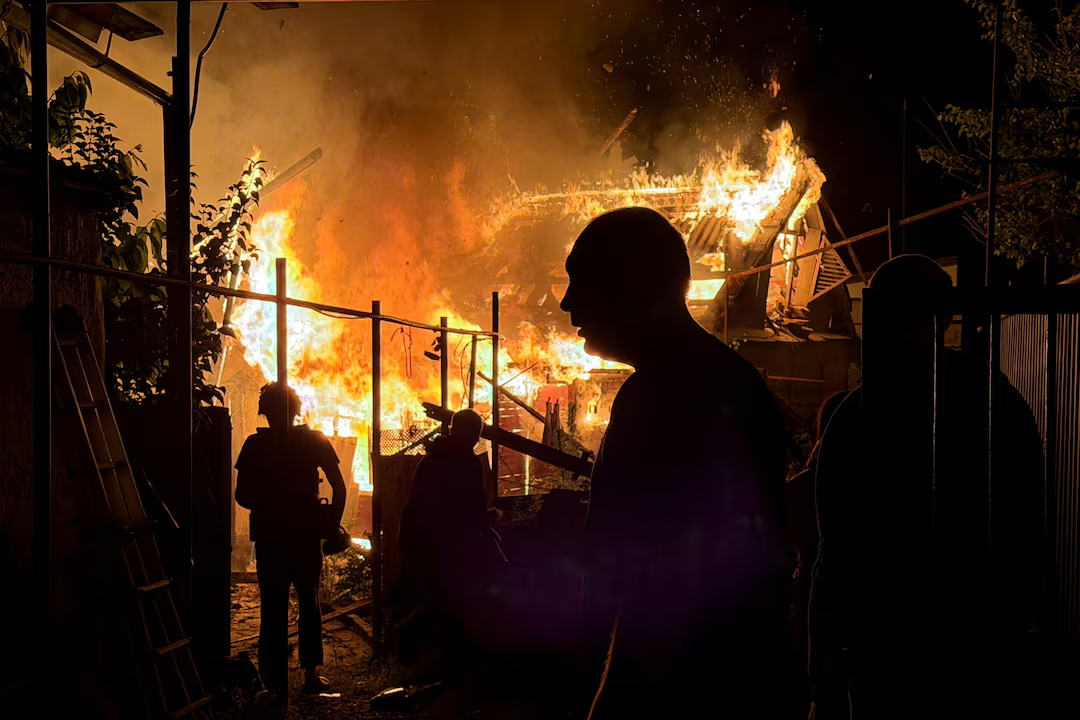
The Russian president also addressed the increasing scale of Ukrainian drone attacks, which have targeted infrastructure including oil refineries and fuel supply chains.
Putin acknowledged that these strikes have contributed to regional fuel shortages inside Russia, though he claimed the situation remains under control.
He called for a rapid increase in the production of air defence systems, stating that Russia must strengthen its ability to counter long-range aerial threats.
“The first task is to quickly and significantly ramp up production of air defence systems,” he said.
Frontline situation and strategic messaging
Putin maintained that Ukrainian strikes on Russian infrastructure do not significantly affect conditions on the battlefield, insisting that operations along the approximately 1,250-kilometre front line continue according to plan.
He also reiterated Russia’s framing of the war as a campaign to secure control over what Moscow refers to as “Donbas and Novorossiya,” a term used to describe occupied and partially occupied Ukrainian territories.
Signals on diplomacy and international involvement
Despite his hardline military stance, Putin suggested that diplomatic channels may remain active.
He referenced possible renewed engagement involving US representatives, including envoys linked to earlier informal discussions, and indicated that further talks could occur after geopolitical tensions involving other conflicts ease.
Putin also mentioned Belarusian President Alexander Lukashenko as a potential facilitator in future negotiations, although he made no reference to Ukraine’s calls for direct presidential talks.
Ukrainian President Volodymyr Zelenskiy has previously proposed face-to-face negotiations, which Russia has rejected.
Outlook
The remarks underscore Russia’s continued commitment to its stated territorial objectives, while acknowledging mounting pressure from Ukrainian long-range strikes. At the same time, Moscow is signaling that while battlefield goals remain unchanged, diplomatic channels—particularly involving third-party mediators—are not entirely closed.